Caldwell County Dog Registration Information
Service Dogs and Emotional Support Animals in Caldwell, Missouri
Registering a Dog in Caldwell County, Missouri (Service Dog or Emotional Support Dog)
If you’re searching where do I register my dog in Caldwell County, Missouri for my service dog or emotional support dog, the most important thing to know is that dog registration (licensing) is usually handled locally—often by a city office if you live inside city limits, or by a county or public-safety office for unincorporated areas. Your dog may be a pet, a working service animal, or an emotional support animal, but local licensing and rabies rules can still apply. This page explains how a dog license in Caldwell County, Missouri generally works, what documents you may need, and how licensing differs from service dog status and ESA rules.
Where to Register or License Your Dog in Caldwell County, Missouri
Because licensing is often handled at the city or county level, the offices below are examples of official local government contacts within Caldwell County, Missouri that residents commonly use for questions about a animal control dog license Caldwell County, Missouri, rabies enforcement, stray/impound procedures, or where to start if you are unsure who issues licenses in your area. Contact the office that matches where you live (city limits vs. county).
Official Offices (Examples)
| Office | Contact & Location | Hours |
|---|---|---|
|
Caldwell County Health Department
Public health & rabies guidance
|
255 W. Main St.
Kingston, MO 64650
Phone: (816) 586-2311
|
Mon–Fri
8:00 AM – 4:30 PM
|
|
Caldwell County Sheriff’s Department
County law enforcement (often first call in unincorporated areas)
|
54 N. Franklin Street
Kingston, MO 64650
Phone: (816) 586-2681
Email: sheriffsadmin@caldwellco.missouri.org
|
Mon–Fri
8:00 AM – 4:00 PM
|
|
City of Hamilton (City Hall)
Example city office that issues dog licenses for residents in city limits
|
200 South Davis Street
Hamilton, MO 64644
Phone: (816) 583-4911
|
Mon–Fri
8:00 AM – 5:00 PM
|
|
City of Braymer (City Hall)
Example city office for residents in Braymer city limits
|
108 East 2nd Street
Braymer, MO 64624
Phone: (660) 645-2355
Email: braymerclerk@gmail.com
|
Mon–Fri
7:30 AM – 3:30 PM
|
|
Caldwell County Clerk (Courthouse)
General county office (helpful starting point if you need to confirm which local unit handles licensing)
|
Caldwell County Courthouse (First Floor)
49 East Main Street
Kingston, MO 64650
Email: clerk@caldwellco.missouri.org
|
Mon–Fri
8:00 AM – 12:00 PM
1:00 PM – 4:30 PM
|
Overview of Dog Licensing in Caldwell County, Missouri
What “registering” usually means
When people ask where to register a dog in Caldwell County, Missouri, they are typically talking about obtaining a local dog license (sometimes called “dog registration”) along with a license tag. Licensing helps local officials identify owners, encourages rabies vaccination compliance, and can be required by municipal ordinance. Your dog can be a family pet, a trained service dog, or an ESA—but the license itself is a local animal-control/administrative requirement, not a disability-status certification.
Most licensing is handled locally (city-by-city)
In Missouri, licensing commonly happens at the city level. In Caldwell County, for example, the City of Hamilton has an ordinance requiring dog licenses and providing for issuance through the city clerk’s office, including a requirement to show proof of recent rabies vaccination as part of licensing. Other towns may have similar rules, while some unincorporated areas rely more on county-level enforcement or complaint-based responses.
Rabies vaccination matters everywhere
Even when the licensing office differs by location, rabies vaccination is a core requirement in most local programs. Many offices will ask for proof of rabies vaccination (such as a vaccination certificate and/or rabies tag number) before issuing a dog license tag. Rabies rules may also affect what happens after a bite, exposure, or impound situation.
How Dog Licensing Works Locally in Caldwell County, Missouri
Step 1: Identify whether you live inside city limits
The first step in figuring out an animal control dog license Caldwell County, Missouri process is confirming whether your address is inside a city boundary (like Hamilton or Braymer) or in the county. This matters because city ordinances often create the licensing requirement and name the issuing office (commonly City Hall or the City Clerk).
Step 2: Gather proof of rabies vaccination and basic information
Licensing applications commonly request owner and dog details (owner name/address and basic dog description). Some cities specifically require proof that the dog has been vaccinated against rabies within a stated timeframe prior to the license application. Keep your rabies certificate from your veterinarian and any rabies tag documentation available.
Step 3: Apply and pay the local licensing fee (if applicable)
If your city requires a license, you typically apply through City Hall/City Clerk, pay the applicable fee, and receive a license tag. Local fees can vary based on whether a dog is spayed/neutered, age, or other factors set by ordinance. If you’re unsure which fee applies, call the appropriate office listed in the section above and ask what documentation is required for your address.
Step 4: Keep tags current and accessible
Many local rules require the dog to wear the license tag (and often the rabies tag) so that, if the dog is found loose, animal control or law enforcement can identify the owner more quickly. If you move within Caldwell County (for example, from county to city limits or between cities), your licensing office may change.
Service Dog Laws in Caldwell County, Missouri
A dog license is not what makes a dog a service dog
A dog license in Caldwell County, Missouri is a local registration tool. It does not “certify” your dog as a service dog. Under the Americans with Disabilities Act (ADA), a service animal is generally a dog individually trained to do work or perform tasks for a person with a disability. Comfort alone is not enough to qualify as a service animal under the ADA.
What public places can ask (and what they can’t)
In most public settings, staff generally may ask only limited questions when the need for a service dog isn’t obvious (for example, whether the dog is required because of a disability and what tasks it is trained to perform). They generally cannot require paperwork, a vest, an ID card, or a “registration certificate” as proof. This is one reason it’s important not to confuse local licensing with disability-related access rights.
Local licensing and rabies rules can still apply
Even if your dog is a trained service dog, you may still need to comply with local animal rules that apply to all dogs (such as rabies vaccination requirements and local licensing in city limits). When in doubt, ask the local office where you live whether service dogs are exempt from local licensing fees or tags (some communities offer exemptions; others do not).
Emotional Support Animal Rules in Caldwell County, Missouri
An ESA is not a service dog under the ADA
An emotional support animal (ESA) is different from a service dog. ESAs are generally not considered service animals for public access under the ADA because they are not required to be individually trained to perform specific tasks related to a disability. If your dog’s primary role is emotional comfort, that can be a valid disability-related need, but it does not automatically create public-access rights everywhere.
Where ESAs most commonly apply: housing
ESAs are most often addressed in housing as “assistance animals,” where a resident may request a reasonable accommodation related to a disability. Housing providers may have processes for requesting accommodations and may request reliable information when the disability-related need is not obvious. Importantly, housing rules and local licensing rules are separate: even if your landlord approves an ESA accommodation, you may still need to comply with local rabies vaccination and licensing requirements.
Avoid “online registrations” that promise legal status
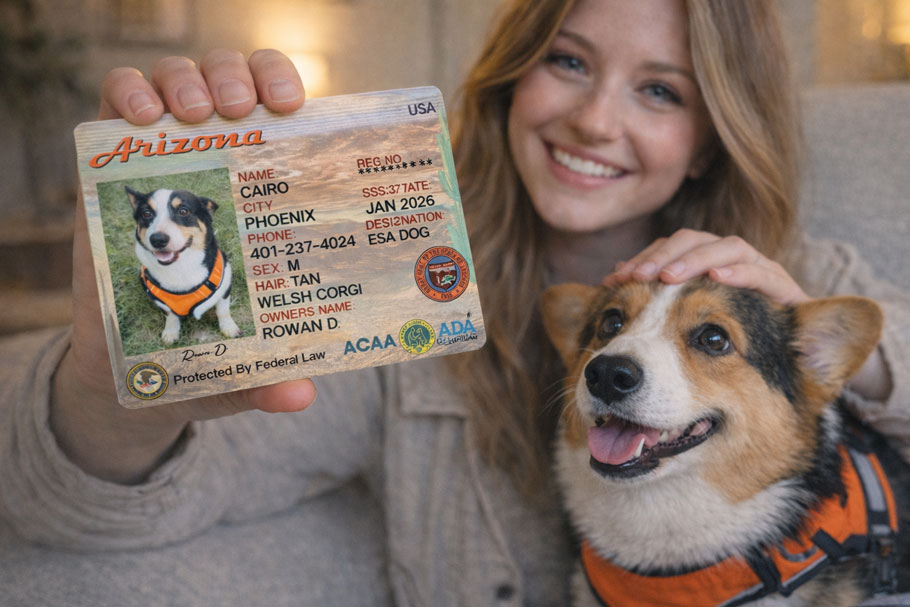
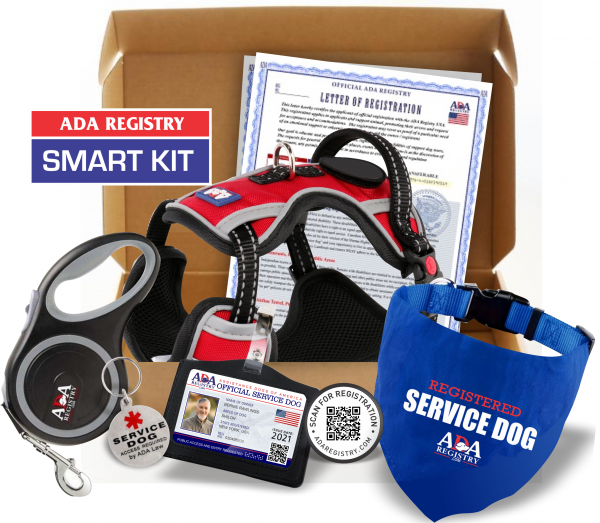
If you’re searching “where do I register my dog…for my emotional support dog,” be cautious about anything that claims to sell “official” ESA registrations or IDs. Local licensing is handled by government offices, and ESA-related rights are typically documented through housing accommodation processes—not through a purchased ID card.
Frequently Asked Questions
If you live inside Hamilton city limits, dog licensing is handled by the city (commonly through City Hall/City Clerk). Call the City of Hamilton office listed above to confirm the current requirements, fees, and what rabies documentation you should bring when applying for a city license tag.
In unincorporated areas, the process can be less standardized than city licensing. Start by calling:
- Caldwell County Sheriff’s Department for guidance on animal control enforcement and the appropriate point of contact for your location.
- Caldwell County Health Department for rabies-related questions (vaccination documentation, bite/exposure reporting guidance, and public health direction).
Service dogs often must follow the same local animal rules that apply to other dogs, including rabies vaccination rules and, in many city limits, local licensing/tag requirements. Because rules can differ by municipality, contact your city office (or county contacts if you are outside city limits) and ask whether any exemption exists for service dogs and what proof is required.
No. A service dog’s legal role is generally tied to ADA task-training and disability-related work/tasks, while an ESA is usually addressed through housing accommodation processes. Neither a service dog nor an ESA becomes “official” because of a purchased online registration. Local dog licensing, on the other hand, is a city/county animal regulation process.
Many local offices accept a rabies vaccination certificate from your veterinarian and/or the rabies tag information. If you are unsure, call the office you plan to use and ask what form of proof they require.
Register A Dog In Other Missouri Counties
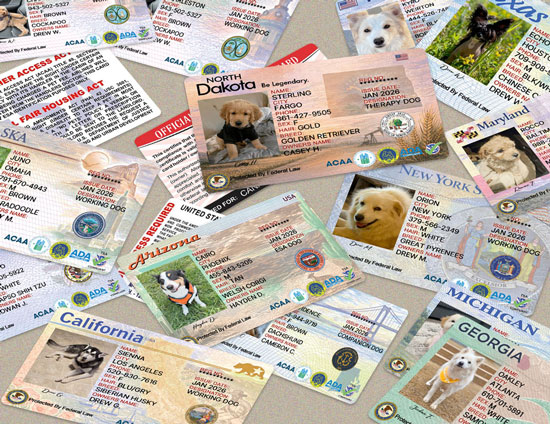
Select your county below to get started with your dog’s ID card. Requirements and license designs may vary by county, so choose your location to see the correct options and complete your pup’s registration.
- Adair County Dog Registration
- Andrew County Dog Registration
- Atchison County Dog Registration
- Audrain County Dog Registration
- Barry County Dog Registration
- Barton County Dog Registration
- Bates County Dog Registration
- Benton County Dog Registration
- Bollinger County Dog Registration
- Boone County Dog Registration
- Buchanan County Dog Registration
- Butler County Dog Registration
- Callaway County Dog Registration
- Camden County Dog Registration
- Cape Girardeau County Dog Registration
- Carroll County Dog Registration
- Carter County Dog Registration
- Cass County Dog Registration
- Cedar County Dog Registration
- Chariton County Dog Registration
- Christian County Dog Registration
- Clark County Dog Registration
- Clay County Dog Registration
- Clinton County Dog Registration
- Cole County Dog Registration
- Cooper County Dog Registration
- Crawford County Dog Registration
- Dade County Dog Registration
- Dallas County Dog Registration
- Daviess County Dog Registration
- DeKalb County Dog Registration
- Dent County Dog Registration
- Douglas County Dog Registration
- Dunklin County Dog Registration
- Franklin County Dog Registration
- Gasconade County Dog Registration
- Gentry County Dog Registration
- Greene County Dog Registration
- Grundy County Dog Registration
- Harrison County Dog Registration
- Henry County Dog Registration
- Hickory County Dog Registration
- Holt County Dog Registration
- Howard County Dog Registration
- Howell County Dog Registration
- Iron County Dog Registration
- Jackson County Dog Registration
- Jasper County Dog Registration
- Jefferson County Dog Registration
- Johnson County Dog Registration
- Knox County Dog Registration
- Laclede County Dog Registration
- Lafayette County Dog Registration
- Lawrence County Dog Registration
- Lewis County Dog Registration
- Lincoln County Dog Registration
- Linn County Dog Registration
- Livingston County Dog Registration
- Macon County Dog Registration
- Madison County Dog Registration
- Maries County Dog Registration
- Marion County Dog Registration
- McDonald County Dog Registration
- Mercer County Dog Registration
- Miller County Dog Registration
- Mississippi County Dog Registration
- Moniteau County Dog Registration
- Monroe County Dog Registration
- Montgomery County Dog Registration
- Morgan County Dog Registration
- New Madrid County Dog Registration
- Newton County Dog Registration
- Nodaway County Dog Registration
- Oregon County Dog Registration
- Osage County Dog Registration
- Ozark County Dog Registration
- Pemiscot County Dog Registration
- Perry County Dog Registration
- Pettis County Dog Registration
- Phelps County Dog Registration
- Pike County Dog Registration
- Plater County Dog Registration
- Polk County Dog Registration
- Pulaski County Dog Registration
- Putnam County Dog Registration
- Ralls County Dog Registration
- Randolph County Dog Registration
- Ray County Dog Registration
- Reynolds County Dog Registration
- Ripley County Dog Registration
- Saline County Dog Registration
- Schuyler County Dog Registration
- Scotland County Dog Registration
- Scott County Dog Registration
- Shannon County Dog Registration
- Shelby County Dog Registration
- St. Charles County Dog Registration
- St. Clair County Dog Registration
- St. Francis County Dog Registration
- St. Louis County Dog Registration
- Ste. Genevieve County Dog Registration
- Stoddard County Dog Registration
- Stone County Dog Registration
- Sullivan County Dog Registration
- Taney County Dog Registration
- Texas County Dog Registration
- Vernon County Dog Registration
- Warren County Dog Registration
- Washington County Dog Registration
- Wayne County Dog Registration
- Webster County Dog Registration
- Worth County Dog Registration
- Wright County Dog Registration